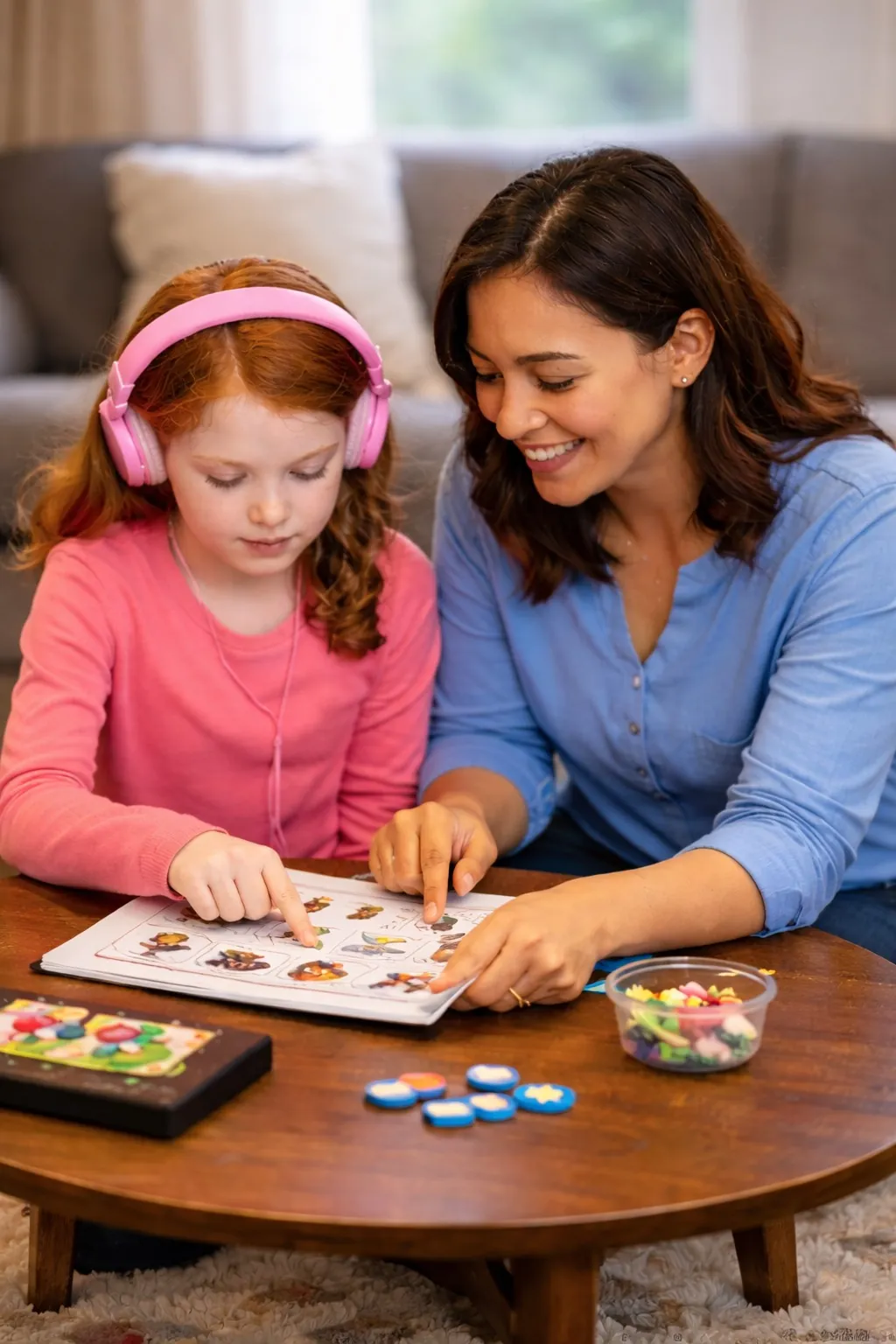
What parent training actually looks like
The name undersells it. "Training" sounds like a class: slides, handouts, a quiz at the end. This is nothing like that. There are no lectures, no homework packets, and no grades. It is coaching, and it happens inside the routines you already live every day.
Coaching during real routines, not staged ones
Your BCBA doesn't hand you a strategy and hope it survives contact with a real Tuesday. Because sessions happen in your home, coaching happens during the actual routine: the real bedtime, the real dinner table, the real scramble to get shoes on. Your BCBA watches how the moment unfolds, then offers one small adjustment at a time, quietly, in the moment, while you stay the parent in charge.
You practice with a spotter
Watching someone else calm your child teaches you very little about doing it yourself at 2 a.m. So you run the strategy while your BCBA stands by, ready to step in or fine-tune. The first attempts are usually clumsy. That is expected and completely fine; clumsy practice with feedback beats polished theory every time.
We adjust together
Some strategies land on the first try. Others fall apart by Thursday, and that is information, not failure. You tell your BCBA what actually happened, the plan gets revised, and you try the new version with coaching. Nobody is grading you, and no one expects a textbook household. We are building something that works in yours.
What changes when parents are part of the plan
Caregiver training is one of the most consistently supported components of ABA in the research literature. We won't invent statistics for you, but here is an honest picture of what tends to differ when parents are in the plan versus watching from the sidelines.
|
With parent training |
Without it |
| Generalization |
Skills practiced with the therapist get practiced with you too, so they show up at grandma's house, in the car, and at the store, not just in session. |
Skills can stay "therapist skills": strong when the RBT is present, shaky the moment they leave. |
| Progress between sessions |
The hours between sessions become practice time. Small, consistent repetitions across the week add up. |
Progress leans entirely on scheduled hours, and hard-won gains can erode between visits. |
| Sibling dynamics |
Parents learn strategies that work for the whole household, and siblings often pick them up too. The home runs on one playbook. |
Siblings and parents respond one way, the therapy team another. Mixed signals slow everyone down. |
| After therapy ends |
The strategies live in you, not in a binder. ABA services end eventually; your skills don't. |
When services taper, the household can feel like the support left with the therapist. |
Skills parents tell us they want first
Every family's plan is different, but the first requests are remarkably similar. These are the modules parents ask for most, and yes, you can start with the one that hurts the most.
- Managing meltdowns. What to do before, during, and after: reading the early signs, keeping everyone safe, staying calm enough to think, and knowing which well-meant instincts actually make things worse.
- Mealtime. Expanding a short list of accepted foods, ending the dinner-table standoff, and separating picky eating you can wait out from feeding problems that need a plan.
- Sleep and bedtime routines. Building a wind-down that actually winds down, handling the ninth curtain call, and shortening the two-hour bedtime without leaving your child distressed.
- Transitions. Leaving the playground, turning off the tablet, getting out the door on a school morning. Small tools like countdowns, visuals, and first-then language do a lot of work here.
- Communication at home. Noticing and honoring your child's current ways of communicating while building new ones, so frustration has somewhere better to go than a scream.
- Siblings. Balancing attention, giving brothers and sisters simple ways to play together, and answering the "why does he get different rules" question without guilt.
- Community outings. The grocery store, haircuts, restaurants, medical appointments. We rehearse the plan at home, then help you run it out in the world.
It's built into every plan
Caregiver involvement is not an upgrade you have to ask for. It is written into every treatment plan we submit, because ABA that ignores the people who live with the child is ABA that stops working at the front door. Insurance plans generally expect a caregiver training component too, and we handle that authorization alongside the rest.
Here is the honest part about time. You do not need to become a therapist, and you do not need free afternoons. Most of what we coach happens inside routines you are already doing; the difference is doing them with a plan. For working parents, sessions can land in the evening or on weekends, because we come to you and we schedule around real jobs. Both parents do not need to attend everything, and a grandparent or nanny who is home more often can be the one we coach. If all you can give some weeks is fifteen focused minutes during one routine, we will build around exactly that, and adjust when life changes.
Where this fits, and what to do next
Parent coaching threads through everything else we do: it runs alongside in-home ABA therapy from day one, connects to classroom strategies through our in-school ABA support, and adapts as kids grow, from early childhood programs to ABA for teens. If you are wondering whether this is the right fit for your family, skip the guessing and book a free BCBA consultation. You will talk with a clinician, not a salesperson, and leave with straight answers about your child, your schedule, and your coverage.
Parent and caregiver training happens in homes across Virginia, including Hanover County, Fredericksburg, and Suffolk. We verify your benefits first; see our insurance page for details.

 💛 Family-Led